
The Early Reflexes That Shape How Children Move, Play, and Learn
Happy National Occupational Therapy Month! Every April, the Flourishing Lives team sets aside time to share all the ways that occupational therapy helps children grow, learn, and participate more fully in daily life. This year, we want to focus on an OT treatment that often flies under the radar: reflex integration.
Reflex integration addresses concerns related to primitive reflexes, another concept many parents aren’t familiar with. However, these reflexes can play a significant role in how children move, regulate their bodies, and interact with their environment.
What Are Primitive Reflexes?
Primitive reflexes are automatic movement patterns that babies are born with. They help infants survive and develop during the earliest months of life.
For example, have you noticed that a baby will automatically close their hand around your finger? That’s one example of a primitive reflex. Another is how babies turn their heads toward touch, which helps them find food.
These reflexes are important during infancy. But as the brain develops, these movements typically fade and are replaced by more controlled, voluntary movements.
However, in some kids, these reflexes remain active longer than expected. As a result, their nervous system may have difficulty organizing movement, posture, attention, or emotional responses.
The Impacts of Primitive Reflexes
Primitive reflexes can influence a wide range of systems, including:
- Balance and body awareness
- Motor planning
- Posture and core strength
- Visual tracking and eye coordination
- Self-regulation and attention
If early reflex patterns remain active, the brain may spend extra energy managing movement, making tasks like handwriting, sitting in class, or coordinating playground activities more difficult.
Addressing these reflex patterns with the Flourishing Lives team can help the nervous system organize movement more efficiently. This is a process known as reflex integration.
A Closer Look at Reflex Integration
Reflex integration helps the brain gradually replace primitive reflexes with more mature movement patterns. We primarily do this through activities that provide structured sensory and movement input to the nervous system. By guiding kids through repeated movement patterns, they can strengthen their body-brain connection.
Strategies We Use to Support Reflex Integration
Rhythmic Movement Activities
Slow, repetitive movements, such as gentle rocking or rhythmic clapping, can help regulate the nervous system and improve coordination. These movements stimulate areas of the brain involved in posture, timing, and body awareness.
Cross-Body Movement
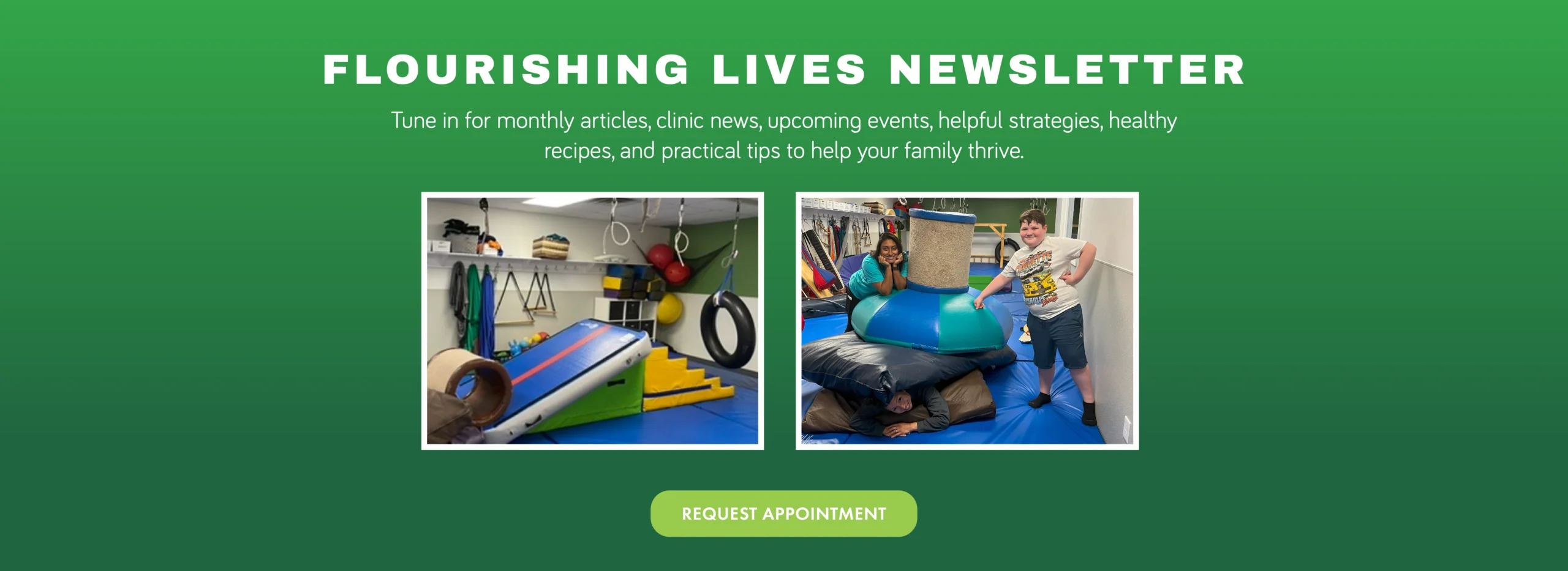
Crossing the midline of the body helps the brain coordinate the right and left sides. To encourage this coordination, we might have kids crawl through an obstacle or have fun with animal walks.
Heavy Work
Activities that involve pushing, pulling, or carrying provide deep pressure to muscles and joints, helping to support body awareness and improve postural stability. Examples include climbing a jungle gym or pushing around weighted toys.
Vestibular Movement
Movement that stimulates the balance system can support reflex integration. Activities like swinging, controlled spinning, or balance games all help the brain interpret movement and maintain equilibrium.
Sensory-Rich Play
Play environments that combine movement, touch, and coordination challenges encourage the nervous system to organize sensory input more efficiently. For this reason, we usually incorporate reflex integration work into play activities.
Supporting Your Child’s Development at Flourishing Lives
Primitive reflexes are a normal part of early development, but when they linger, they can influence how the body processes movement and sensory information later in childhood. Fortunately, our OTs can help identify these patterns and provide activities that support more mature motor control, coordination, and self-regulation. Reach out to Flourishing Lives today to learn more about how occupational therapy can support your child’s growth and confidence, especially if you have questions about your child’s movement patterns or sensory experiences. As occupational therapists, we’re here to help!
Has Your Child Retained Primitive Reflexes?
It can be difficult to tell if your child has held onto their primitive reflexes. Because the signs can look like everyday struggles, they’re easy to miss.
Complicating matters is the fact that every child is different, so it’s not a matter of picking out one or two behaviors. Rather, you want to watch out for patterns, particularly across several areas, as this can indicate that your child’s nervous system is working harder to organize movement and sensory input.
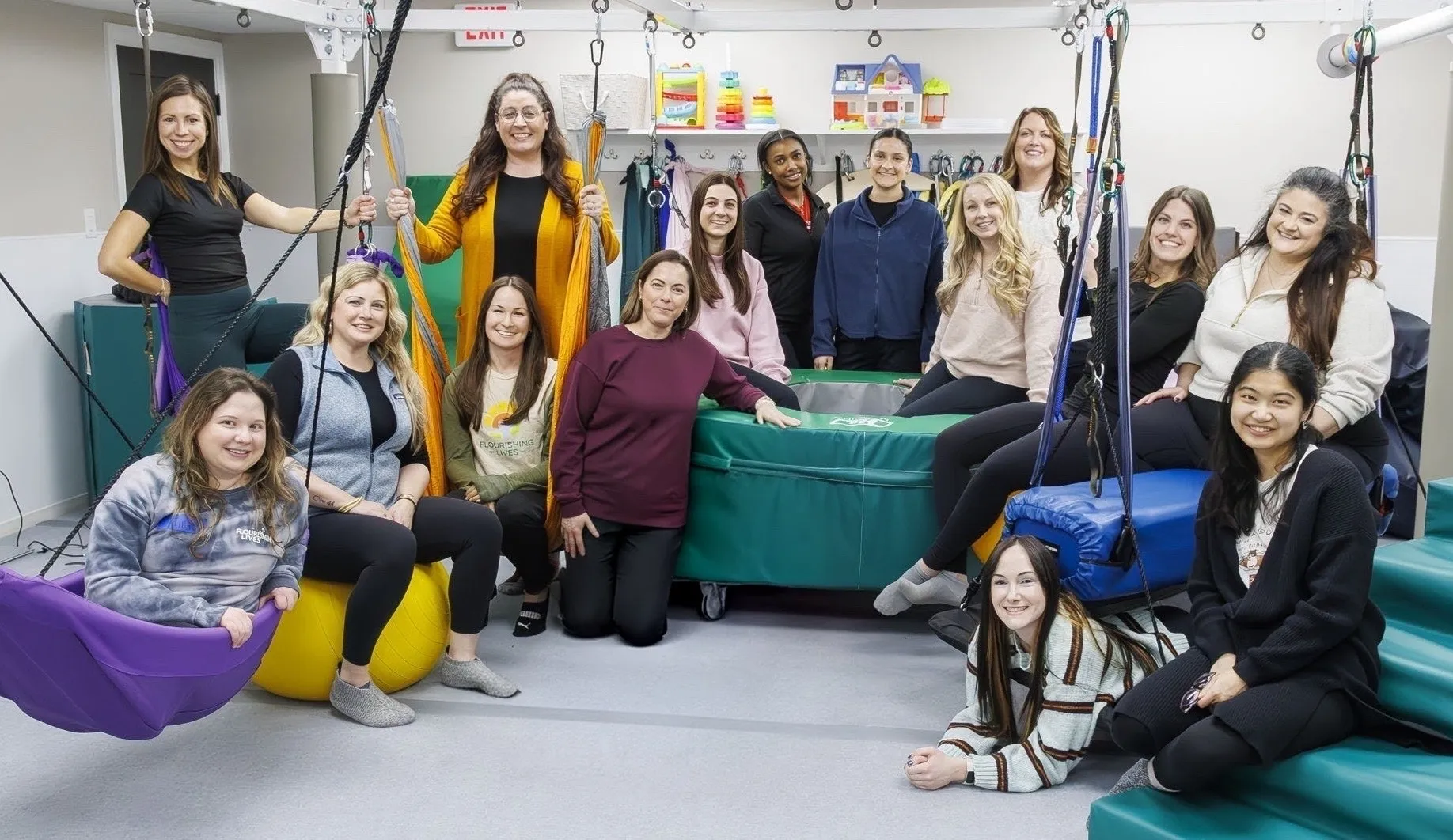
And when in doubt, the Flourishing Lives team is always here to help.
Common Signs of Retained Primitive Reflexes
Movement and Coordination
- Frequent tripping or bumping into objects
- Difficulty learning activities like bike riding or ball skills
- Poor balance or trouble standing on one foot
- Awkward or stiff movements during play
Posture and Body Control
- Slouching or leaning heavily on desks or tables
- Difficulty sitting upright for extended periods
- Wrapping legs around chair legs or sitting on feet
Fine Motor Challenges
- Fatigue during writing, coloring, or cutting
- Very tight or very loose pencil grip
- Slow or messy handwriting
Sensory Responses
- Strong startle reactions to sudden movement or noise
- Sensitivity to certain textures, clothing, or touch
- Seeking constant movement, such as jumping or crashing into furniture
Attention and Regulation
- Difficulty staying focused on tasks
- Restlessness during seated activities
- Becoming overwhelmed in busy environments
When Should You Consider an OT Evaluation?
If these signs interfere with your child’s ability to participate in daily activities, an occupational therapy evaluation may be helpful. We also recommend reaching out to our team if your child:
- Struggles with coordination compared to peers
- Avoids physical play or becomes easily frustrated with movement tasks
- Has persistent difficulty with writing, posture, or attention
- Shows strong reactions to sensory experiences like sound, movement, or touch
During an evaluation, we’ll assess how your child processes movement and sensory information. The process typically includes observing posture, coordination, and reflex patterns. This information can help us better understand why your child might be struggling, so we can create a care plan that meets their needs.
Support Is Here When Your Child Needs It
Many children benefit from extra support as their nervous systems develop. With the right activities and guidance, children can improve coordination, regulation, and confidence in everyday tasks. If you suspect your child might have retained their primitive reflexes, reach out to Flourishing Lives. Early support can make daily activities easier and more enjoyable for the whole family.
Patient Spotlight:
Lucas
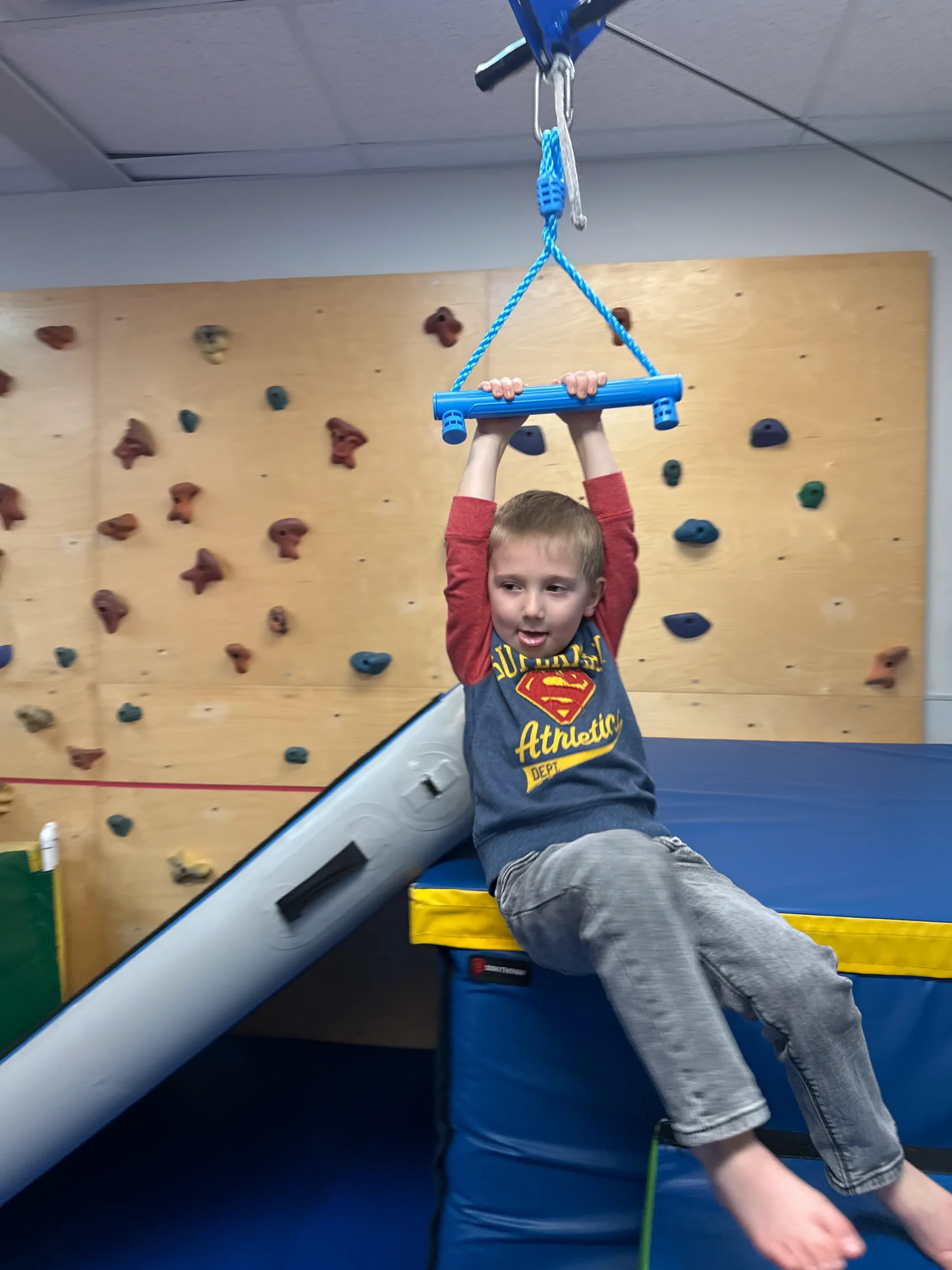
Lucas is a sweet and engaging little boy who began coming to Flourishing Lives for occupational therapy a few months ago. He began with various fears, sensory difficulties, and challenges regulating his emotions, which impacted his ability to engage in daily activities and self-care at home, school, and in the community. These included difficulty going to the doctor, getting his haircut, or adapting to new tasks.
With OT, Lucas has made amazing strides in trying new things, adapting and communicating with peers, and regulating his emotions. He is now able to participate in all of these with increased ease! Where transitions and touching shaving cream used to be very difficult, he now shows decreased dysregulation and engages in messy play.
Lucas’ mom even shared her excitement, saying, “The amount of growth that I have seen in Lucas is amazing. Overall, I started therapy with what I thought was just a sassy four-year-old who wanted his way. Through coaching and watching, I realized that he was needing more. Therapy has been everything I had ever hoped it would be, and he has made amazing strides. He wasn’t just sassy and vocal; he needed to understand emotions and how to handle them. I can’t recommend and thank this team enough. We have just completed our first round, and I already see so many good things!!!”

Staff Spotlight:
Alexis
Alexis is an occupational therapist who started at Flourishing Lives in April 2025. Graduating from Michigan State University with a B.S. degree in Neuroscience and a minor in Cognitive Science, she went on to receive her master’s degree in Occupational Therapy from Washington University in St. Louis in 2024. She chose these areas of study because of a love for learning about how the brain grows, changes, and interacts with our environment, as well as exploring how it plays a role in every part of life. Using this knowledge and her skillset, she is committed to making a positive impact and helping children and families thrive.
Alexis’ favorite part about being an occupational therapist is finding creative ways to have fun while empowering children to grow life skills. She is passionate about seeing the world through each child’s eyes and about building confidence and skills to navigate it. Outside of work, she enjoys reading, crocheting, photography, and yoga. She also loves traveling and spending time with family and friends.
Helping Families Thrive
Activity of the Month:
Playful Ways to Support Reflex Integration
Movement is one of the most powerful tools for helping kids organize their nervous systems. Many early reflex patterns respond well to repeated movement, balance challenges, and activities that strengthen body awareness, which makes them easy to feel like playtime.
Here are a few of our favorites:
1. Animal Walk Obstacle Course
Animal walks encourage cross-body movement, helping the brain connect the right and left sides, which supports motor planning and attention.
How to Play
First, create a short obstacle course using pillows, cones, or other objects. Then, encourage your child to move through the course, but with a twist: they need to use various animal walks. Here are a few to get you started:
- Bear walks, with both hands and feet on the floor
- Crab walk, with the hands and feet supporting the body while facing upward
- Frog jumps
2. Rolling Log Game
Rolling movements provide calming input to the nervous system and help organize body awareness.
How to Play
Start with the basics. Have your child lie on the floor with arms stretched overhead, then ask them to roll across the floor like a log.
You can then add in fun challenges, such as:
- Rolling to reach a stuffed animal.
- Rolling across a blanket “river.”
- A rolling race, in which you join in to see who can roll the farthest.
3. Cross-Body Ball Toss
This is another fun activity that involves crossing the midline to strengthen communication between the two sides of the brain. It also builds coordination, timing, and attention.
How to Play
Start by standing a few feet away from your child. You’ll then toss a soft ball toward their left side, but they need to catch it with their right hand. After a few rounds, switch sides.
Once your child gets the hang of things, try mixing it up. You might have them try to catch while standing on a couch (or another surface that challenges their balance). Or incorporate some word or number games: for example, you might have your child count each catch or call out the color of a nearby object when they toss the ball back to you.
Community Events
April 11, 2026: RARA (Rochester Avon Recreation Authority) Special Needs Resource Fair
April 25, 2026: Pathway to Hope Wellness Walk at Innovation Hills
April 26, 2026: Best Buddies Walk at the Detroit Zoo
Recipe of the Month:
Carrot Cupcakes

Ingredients:
- 1 large carrot
- 3/4 cup unsweetened applesauce
- 2 large eggs
- 1/4 cup maple syrup or honey (can increase 1/3 if you’d like the cupcakes a little sweeter)
- 1/4 cup vegetable oil
- 2 tsp vanilla extract
- 1 tsp cinnamon
- 1/2 tsp ground ginger
- 1 tsp baking powder
- 1/2 tsp baking soda
- 1/4 tsp fine salt
- 3/4 cup whole wheat, all-purpose, or gluten-free flour
- 1 1/4 cups quick-cook 1-minute rolled oats
- 1/3 cup raisins (optional)
- other optional add-ins: 3 Tbps hemp seeds and/or 1/4 cup chopped nuts (walnuts or pecans)
Quick Cream Cheese Frosting
- 4 to 6 oz whipped cream cheese
- 2 to 3 Tbsp maple syrup or honey (more or less to taste)
- 1/4 tsp vanilla extract or vanilla paste
Directions:
- Heat the oven to 350 degrees. Place 10 paper muffin liners in a muffin pan or grease the muffin pan with oil spray.
- Peel the carrot, then shred it on the smaller holes of a box grater until you get a packed 3/4 cup of grated carrot.
- In a large bowl, whisk together the applesauce, eggs, maple syrup, oil, and vanilla. Add cinnamon, ginger, baking powder, baking soda, and salt. Whisk to combine. Stir in the grated carrot.
- Add flour and oats to the bowl. Using a large spoon or rubber spatula, stir until just combined. Add in raisins and any other add-ins, if using.
- Scoop the batter into your muffin cups. Bake until cooked through and lightly browned on the top, about 12 to 15 minutes.
- Enjoy the muffins as is or let them cool completely before topping with cream cheese frosting and optional spring-colored sprinkles.
Feel confident at the table again—without the power struggles
Mealtimes don’t have to be this hard
- You’re doing everything you can—cutting food just right, offering all the favorites, reading every tip online.
- And still, your child refuses to eat. Or cries. Or gags. Or throws their plate.
- You’re not failing. You’re just missing the right support.
- “Let’s change that”