

How Small Moments Can Have a Big Impact on Kids’ Development
February’s cold weather makes it the perfect month to reconnect with the things that matter most: relationships, daily routines, and overall growth. And this is as true for kids as it is for adults, which is why the team at Flourishing Lives is dedicating February to the small ways you can improve your child’s development.
Exploring the Link Between Everyday Moments and Practical Development
It’s important to remember that your child’s development doesn’t just happen during their therapy sessions. Rather, it’s the everyday moments that really help your child build the skills they need to thrive in daily life. Playtime, movement, communication, and connection can all reinforce the work your child does during therapy.
There’s a simple reason for this: Sensory processing and communication are closely connected. When your child feels calm and organized in their body, they’ll have an easier time listening, learning, and expressing themselves. Likewise, strong communication skills help children express their needs, navigate social situations, and regulate emotions more effectively.
This is one reason why families play such a powerful role in supporting a child’s development. When you support sensory regulation and communication throughout daily routines, your child is constantly learning, building confidence, and engaging with the world around them.
Fortunately, supporting these skills doesn’t require complicated tools or extra time. Simple, intentional interactions throughout the day can have a meaningful impact. Whether you’re talking your child through a task or incorporating fun movement into playtime, you’re helping reinforce the skills your child is building in therapy.

You’re Invited
A Community Open House & Ribbon Cutting
Date: 2/9/26
Address: 811 Oakwood Dr, Suite 102
Rochester, MI 48307
Time: 3:00 PM to 6:00 PM
Why We’re Reaching Out: We believe strong communities are built through collaboration.
- Be our guest as a community partner
- Attend our ribbon-cutting & open house
- Contribute an item for family giveaways (optional)
How We’ll Support You: This is about community, connection, & supporting families who live & grow here.
- Feature you on our social media
- Added to our referral resource list
- Recognized at the event
Our Rochester Clinic is Now Open!
We’re pleased to announce that you can now visit our new clinic in Rochester. If you live in the area, we have immediate openings available for both speech therapy and occupational therapy, and our team would love to work with your family!
You can make an appointment at our Rochester location by calling 586-293-1234 or reaching out online. We’re also hosting an open house on February 9th to connect with the local community, and we’d love to see you there.
A Practical Tool To Help Your Child Thrive
This month, Flourishing Lives wants to help you feel even more confident in supporting your child’s development at home. That’s why we’re sharing our February Parent Tip Series below. Each week features an easy, practical tip to support sensory integration and communication in day-to-day life. And if you’d like more suggestions or more personalized guidance, don’t hesitate to contact our clinic.
After all, the most meaningful progress often occurs in the moments you’re already sharing with your child.
February Parent Tip Series
Supporting Sensory & Communication Skills at Home
Week 1: Incorporate Regular Movement Breaks
When children feel calm and organized in their bodies, communication comes more easily. To support regulation, weave in movement breaks before communication-based activities such as homework, meals, or conversations. Try:
- Jumping jacks
- Wall push-ups
- Animal walks
These activities help support attention, listening, and expressive language.
Week 2: Use Everyday Routines to Build Language
Daily routines are great opportunities to support speech and language in an easy, natural way. For example, you might:
- Explain which ingredients you’re using as you prepare a meal, and ask your child to describe each one
- Walk your child through the different steps involved in bath time, like lathering up soap or squeezing out shampoo
- Ask your child to share the different textures or sensations of getting dressed.
The exact activity doesn’t matter so much as the conversation. Use simple phrases, ask choice-based questions, and encourage your child to label items or actions.
Week 3: Schedule Sensory Play Sessions
Hands-on sensory play, such as playdough, water play, or building with blocks, offers more than just fun! These activities can help support regulation and enhance both fine motor and communication skills.
Throughout playtime, encourage your child to describe the different textures, sensations, and actions they’re enjoying. The play itself will help your child build dexterity in their hands and fingers, while talking through their experiences helps expand vocabulary and enhance communication.
Week 4: Focus on Connection
Don’t underestimate the power of meaningful connection in supporting sensory regulation and communication. Part of what makes small moments so powerful is that they happen consistently–often without you even realizing it. So this week, be more mindful as you connect with your child:
- Follow their lead during playtime
- Join in and celebrate their unique interests
- Get down on their level
When children feel understood and connected, they are more motivated to communicate and engage.
We’re Here if You Need More Guidance!
At Flourishing Lives, occupational therapy and speech therapy work together to help your child build the skills they need to navigate through the world. But we’re also here to help you and your family feel confident in supporting your child at home. So if you have any questions, reach out to our clinic today!
Patient Spotlight:
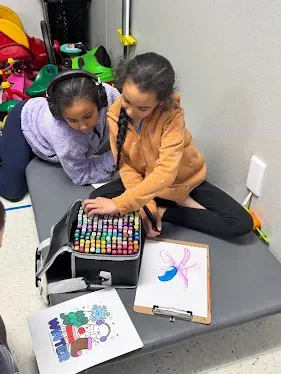
Siblings Finley & Freya
Finley has been participating in occupational therapy with Flourishing Lives for about one year. She began with significant behaviors and fears that impacted her ability to engage in age-appropriate social situations, play, and daily activities, such as going to the bathroom on the toilet. Now with OT, craniosacral therapy, and the Safe and Sound protocol, Finley has made amazing progress in her daily routine. She is more confident in her ability to communicate with peers and play with others, and she even participates in group dance classes. In addition, she is now able to use the bathroom with ease, making her and her family’s lives easier.
Freya has participated in occupational therapy at Flourishing Lives for nearly six years and has made significant gains in her emotional regulation, sensory integration, attention, focus, motor planning, and coordination. All of these improvements have enhanced her ability to participate in daily routine, play, education, and social interactions with family and peers with decreased assistance from caregivers.
Freya is now able to manage her emotions to communicate her needs and wants without frequent meltdowns. She is able to engage in back-and-forth play with her sister and family members for longer periods of time, with less control over the play and less need for redirection back to the activity.
Staff Spotlight:
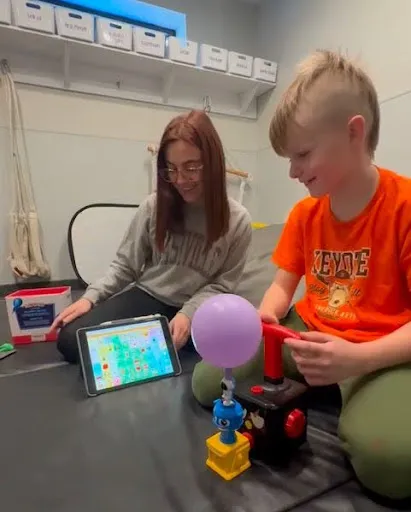
Nicole Kelly
Nicole began her journey as a speech-language pathologist at Grand Valley State University and earned her Master’s degree from Wayne State University. She is an NLA-trained clinician through the Meaningful Speech Course and PROMPT-trained through the PROMPT Institute. Nicole has special interests in Augmentative and Alternative Communication (AAC), autism, gestalt language processing, and childhood apraxia of speech.
Nicole believes in neurodiversity-affirming, child-led therapy and focuses on connection over compliance. She values play-based learning and works to create a safe, supportive environment where individuals can grow at their own pace and feel confident in their communication.
Outside of work, Nicole enjoys reading, rollerblading, and spending time with friends and family. She is passionate about building meaningful connections and celebrating the unique strengths of every individual she works with.
Helping Families Thrive

Activity of the Month:
Valentine-Themed Sensory & Speech Play
Celebrate Valentine’s Day with these fun, simple activities that support both sensory interaction and communication skills at home! Each of these ideas creates playful moments to help strengthen regulation, language, and connection–all while having some holiday fun.
Valentine Sensory Bin
Create a Valentine’s Day sensory bin filled with rice, red beans, or shredded red and pink paper. Add some fun Valentine’s toys, such as stuffed animals or fake roses, plus plenty of utensils, cups, or other containers for scooping and playing.
How to Build Skills During Play
- Talk about colors, textures, and sizes
- Practice requesting items (“I want the red heart”)
- Work on following directions (“Find two small hearts”)
- Encourage descriptive language, such as words like “soft,” “smooth,” or “rough”
Heart Movement Game
Cut out paper hearts and lay them around the room to create a path for your child to follow. Ask your child to move between them by jumping, crawling, or tiptoeing. This activity helps improve both body awareness and coordination.
How to Build Skills During Play
- Practice turn-taking and listening
- Use action words like jump, crawl, stop, and go
Read and Connect
Choose a Valentine-themed book and read it with your child. Throughout the book, pause to ask questions, label pictures, and talk about how the story makes you and your child feel.
Recipe of the Month:
White Chocolate-Strawberry Snack Mix
This adorably pink snack mix is a simple and tasty Valentine’s Day treat, thanks to the combination of two cereals that add varying texture and crunch. Heart-shaped sprinkles make it extra festive, but you can use any sprinkles you have on hand.

Ingredients:
- One 1.2-ounce bag freeze-dried strawberries (about 1 1/2 cups)
- 1 cup confectioners’ sugar
- 5 cups crisp rice cereal squares, such as Rice Chex
- 4 cups honey whole-grain oat cereal, such as Honey Nut Cheerios
- Three 4-ounce bars of white chocolate, chopped
- 1 cup pink candy-coated chocolates, such as pink M&M’s
- 1/4 cup red and white sprinkles
Directions:
- Pulse the freeze-dried strawberries in a food processor until very finely ground, with a powdery texture. Alternatively, place in a resealable bag and crush with your hands or a rolling pin until very finely and evenly ground.
- Transfer to a small bowl and whisk in the confectioners’ sugar until combined. Set aside.
- Pour the rice cereal squares and honey whole-grain oat cereal into a large bowl.
- Put the chopped white chocolate in a medium microwave-safe bowl. Microwave at 50% power in 15-second intervals, stirring occasionally, until just melted and smooth, about 1 minute.
- Pour the melted chocolate over the cereal mixture, then gently toss with a rubber spatula until evenly coated.
- Pour the strawberry-sugar mixture over the chocolate-coated cereal, then toss again until every piece is nicely coated and pink.
- Stir in the candy-coated chocolate and sprinkles.
- Store in an airtight container for up to 5 days.

Feel confident at the table again—without the power struggles
Mealtimes don’t have to be this hard
- You’re doing everything you can—cutting food just right, offering all the favorites, reading every tip online.
- And still, your child refuses to eat. Or cries. Or gags. Or throws their plate.
- You’re not failing. You’re just missing the right support.
- “Let’s change that”