
Easing the Back-to-School Transition
How Occupational Therapy Can Help You Start the Year Strong
School days will be here before you know it! With new teachers and new friends, this time of year can certainly be exciting. However, the transition also brings big changes to your child’s life: a different routine, new daily expectations, and unfamiliar sensory input. For many kids, these changes can feel overwhelming.
Fortunately, the occupational therapists at Flourishing Lives are here to help you and your family navigate this transition. Here are some of our favorite tips to make this school year the best one yet!

Four OT-Approved Strategies for Returning to School This Fall
- Gradually Reintroduce Daily Routines: Consistent routines are one of the most important ways to help ease the transition out of summer. They help kids feel more secure and in control, which reduces stress, increases independence, and helps them thrive at home and in the classroom. Here’s how to build structure before that first day back:
- If your child’s sleep schedule has become less school-friendly during the summer, gradually re-adjust bedtime and wake-up time in 15-minute increments each day.
- Practice school-year morning routines, such as brushing teeth, getting dressed, and eating breakfast at the same time each day.
- To help kids stay on track, use visual supports, including charts, checklists, or picture schedules–whatever works best for your child.
- Strengthen School-Ready Skills: Make time before school starts to practice the skills your kids will use in the classroom. This can help reduce anxiety before the first day. Here are some suggestions to get you started:
- Prep fine motor skills and strengthen hand muscles by coloring, using scissors, and playing pencil games.
- Work on gross motor skills through activities that build core strength and coordination, such as animal walks, yoga poses, or just playing in a jungle gym.
- Encourage seated activities at a table to simulate school-day demands.
- Prepare for New Sensory Experiences: From buzzing lights to scratchy uniforms, classrooms can be full of sensory surprises. Help your child build a toolbox of calming strategies so they don’t come to class unprepared. Try these ideas:
- Practice deep breathing by pretending to blow out birthday candles
- Try chewing gum or crunchy snacks for oral input
- Experiment with fidget tools or stress balls
- Practice Emotional Regulation: Big feelings are normal, especially when you’re going through big changes. Talk to your child about what school might be like, what they’re excited about, and what they’re worried about. Then take some time to practice ways they can manage their feelings, such as:
- Sharing social stories about their upcoming school routine
- Role-playing common scenarios, like asking for help or following directions
- Creating calm-down spaces and discussing cues for managing frustration

Looking for More Guidance? Our Team Is Here for You!
Every child transitions differently, and that’s okay. With thoughtful planning and consistent strategies, you can set your child up for a confident and connected start to the school year.
And remember, if your child needs extra support with motor skills, sensory regulation, or other concerns, you don’t have to do it alone. The Flourishing Lives occupational therapists are here to help. Just schedule an appointment to get started.
Find School-Day Success with These Morning Gross Motor Activities
Did you know starting the day with movement can help your child focus, stay calm, and regulate their energy throughout the school day? It’s true! Many children benefit immensely from a gross motor warm-up before they head to class. This is especially true for kids with sensory processing challenges, attention difficulties, or low muscle tone–getting moving first thing can make a big difference in how they feel and function at school.

The Importance Of Gross Motor Skills
The term “gross motor skills” refers to big body movements like jumping, running, and climbing. Incorporating just 5–10 minutes of purposeful movement into your child’s morning routine can help:
- Set a positive tone for the day
- Wake up the body and brain
- Regulate energy levels (whether calming or alerting)
- Support core strength and posture
- Improve focus and readiness to learn
Tips for Making the Most of Gross Motor Time
- Do it consistently, even if it’s just a few minutes.
- Use visual schedules to build it into the routine.
- Let your child choose or lead the activity when possible.
- Pay attention to how your child responds. Some may need calming activities, while others may benefit from more active movement.
Try These Fun Morning Gross Motor Activities
- Animal Walks: Encourage your child to walk like an animal! For example, they might lumber like a bear, skitter like a crab, jump like a frog, or slither like a snake.
- Key Benefits: Animal walks engage the whole body and provide proprioceptive input (deep pressure), which can be very regulating.
- Wall Pushes or Chair Push-ups: These are essentially modified pushups. You might have your child stand against a wall and push back and forth on it. Or, if they need a little more, ask them to perform a push-up at an angle, off a sturdy chair (no wheels!) or similar piece of furniture.
- Key Benefits: This movement is great for waking up muscles and grounding the body.
- Yoga Poses or Stretching: Yoga is a wonderful way to work on gross motor skills. Try kid-friendly poses like downward dog, cat-cow, or child’s pose. You might also guide them through a sun or moon salutation.
- Key Benefits: Yoga helps calm the nervous system and increase body awareness.
- Obstacle Course: Set up a simple indoor obstacle course using pillows, chairs, or tape on the floor and encourage your child to crawl over, under, and around.
- Key Benefits: Obstacle courses build strength, coordination, and endurance while encouraging problem-solving skills.
- Morning Dance Party: Set aside a few minutes to play your child’s favorite song and encourage them to dance their heart out. You might even find yourself joining in.
- Key Benefits: In addition to working on gross motor skills, dancing improves cardiovascular health and helps with stress relief. It’s also just plain fun.
- Jumping Activities: Set up a hopscotch path on the sidewalk, schedule some trampoline time, or have a jumping jack contest.
- Key Benefits: Jumping supports balance and helps build good motor planning skills.
- Walk to School (or Take a Walk Before Drop-Off): If walking, biking, or scootering to school or a bus stop is an option for your family, it absolutely counts as a gross motor activity! Even if it’s not an option, a quick walk around the block before drop-off can have similar benefits.
- Key Benefits: Walking is an excellent all-around exercise, and if you can walk to school or a bus stop, it serves as a great transition activity.
For Extra Help, Meet With Our Occupational Therapists
If you notice that your child is really struggling with paying attention, sitting still, or transitioning into the school day, they may benefit from a personalized sensory-motor routine developed by one of the Flourishing Lives occupational therapists. Contact our clinic to schedule an initial consultation. Together, we can set your child up for regulation, confidence, and success before the school bell even rings!
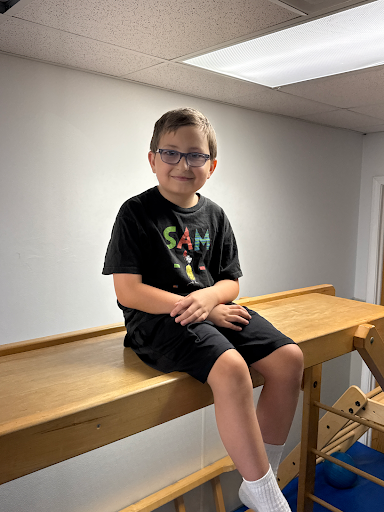
Patient Spotlight: Sam
Let’s celebrate Sam’s Growth and Confidence!
This month, we’re proud to celebrate the incredible progress of one of our young patients, Sam!
Sam has made meaningful strides both at home and in the community, including bravely taking the Eucharist at his First Holy Communion and expanding the variety of foods in his diet. His willingness to try new foods has grown, and his mealtimes are now filled with more curiosity and less hesitation.
Sam is also showing amazing perseverance, especially when learning to ride a bike! Challenges that once felt overwhelming are now met with determination and a positive attitude. During therapy sessions, his growing confidence is clear as he takes on new and more challenging activities without hesitation.
One of the most exciting changes has been his ability to manage frustration. Sam is learning to stay calm and keep trying, even when things don’t go as planned. His increased confidence is helping him communicate more with others and embrace new experiences with bravery.
We are so proud of all that Sam has accomplished and can’t wait to see what he does next!
Community Events
August 7 | Care Family Resource Fair
August 16 | MISD Health and Wellness Fair
August 19 | Head Start Fair

Staff Spotlight: Lauren Taylor
Lauren is a passionate pediatric occupational therapist specializing in sensory integration. She has been part of the Flourishing Lives team for over two years, helping children build essential sensory, motor, and daily living skills. Before transitioning to pediatrics, she gained valuable experience in neurorehabilitation and inpatient rehab, deepening her understanding of motor recovery and functional independence.
Her approach to therapy is both professional and deeply personal. Having navigated her own sensory challenges, she brings a unique level of empathy and connection to her work. She understands firsthand the struggles that come with sensory processing difficulties and is dedicated to helping others find strategies that promote regulation, confidence, and success.
With a holistic mindset, she integrates principles from craniosacral therapy, fascial therapy, sensory integration, polyvagal theory, nutrition, bioenergetics, and sleep science into her work. Committed to lifelong learning, she continuously seeks new ways to support children’s well-being.
Outside work, she finds joy in nature, hiking, cooking, gardening, drawing, and art. Most of all, she cherishes time spent with friends, family, and her big Bernedoodle buddy, Roman.
Helping Families Thrive
Activities of the Month: Seven Ideas for Outdoor Gross Motor Play
Outdoor gross motor play offers a wealth of benefits for kids. Being in nature has a calming effect and can help boost cognitive development, such as improved focus and problem-solving skills. Plus, these big movements can help prepare the body and brain for structured tasks like learning and sitting in class.
- Obstacle Course Adventure: Use chalk, cones, buckets, or natural features like trees and curbs to create an obstacle course. Encourage as many different movements as you can, such as:
- Jumping over lines
- Crawling under low branches
- Balancing along a curb or plank
- Running or skipping to a target
- Ball Games: Games that involve kicking, throwing, and catching–such as soccer, basketball, or even just a simple game of catch–can improve hand-eye coordination, motor planning, and teamwork skills.
- Climbing and Hanging: Climbing on a jungle gym or a very sturdy tree helps strengthen the core and upper body. Hanging from the branches or bars provides calming proprioceptive input.
- Races and Relay Games: Make running and walking more engaging with sack races, three-legged races, timed sprints, or egg-on-a-spoon walks. These activities build strength, timing, and self-regulation under pressure.
- Bubble Chase: Blowing and chasing bubbles is a great way to improve breath control and visual tracking. It also encourages your child to run and jump with purpose.
- Sidewalk Chalk Games: Create hopscotch grids, jumping paths, or mazes. Get creative with alphabet- or number-themed hopscotch, or design animal tracks for your child to follow. Ask your child to help design the path for an extra boost of creativity.
- Nature Scavenger Hunt with A Twist: Scavenger hunts are a great way to get moving on their own, but you can add an extra boost by incorporating movement challenges, such as:
- Hop to a pinecone
- Crab walk to the big tree
- Bear crawl to a rock

Recipe of the Month: Edible Slime Pudding
Ingredients:
- 1/4 cup instant pudding mix, any flavor
- 1 cup corn starch (may need a little more)
- 1/3 cup warm water (may need a little more)
Directions:
- Add instant pudding mix and 1/2 cup of cornstarch to a mixing bowl. Add 1/3 cup water and stir until slime begins to form.
- Slowly add the rest of the cornstarch, stirring as you go.
- When slime becomes difficult to stir with a spoon, finish mixing by hand.
- If the slime is still sticky, add more cornstarch. If the slime is too thick, add more liquid. Keep going until you have the perfect texture.
Feel confident at the table again—without the power struggles
Mealtimes don’t have to be this hard
- You’re doing everything you can—cutting food just right, offering all the favorites, reading every tip online.
- And still, your child refuses to eat. Or cries. Or gags. Or throws their plate.
- You’re not failing. You’re just missing the right support.
- “Let’s change that”