


Seeing Holiday Gatherings Through Your Child’s Eyes
How to Support Sensory Regulation, Mealtimes, and Communication During Family Celebrations
Imagine walking into a party in a place you’ve never been, filled with people you’ve never met. And yet everyone is excited to see you. They keep asking questions about what you’ve been up to and hoping for a hug. You head over to the snack table for a break, only to find it covered in foods you’ve never seen before.
Sounds overwhelming, doesn’t it?
For children with sensory processing challenges, this is exactly what holiday gatherings can feel like. While adults look forward to festive celebrations as a chance to unwind and relax, kids often struggle with the barrage of loud noises, bright decorations, and disruptions to their usual routines, making participation harder.
Fortunately, a little preparation and understanding can help your child feel more comfortable, confident, and ready to participate in the festivities.
Why Holiday Gatherings Can Feel Overwhelming
The main reason kids struggle with holiday gatherings is that they introduce a lot of unfamiliar sensory experiences all at once. If your child struggles to process sensory information, they may have difficulty managing everything happening around them.
Here are just some of the reasons why holiday gatherings can leave kids feeling overwhelmed, anxious, or exhausted:
- Sensory overload from loud conversations, crowded rooms, and strong smells
- Disruptions to your child’s day-to-day routine
- New environments and unfamiliar faces
- Pressure from social expectations like meeting relatives, answering questions, or participating in group activities
If these sensory demands become too intense, your child might struggle to regulate their emotions, causing them to withdraw or even experience a meltdown. However, these reactions aren’t signs of misbehavior–it’s just that your child is struggling to process their surroundings.
Fortunately, there are several things you can do to help make holiday celebrations easier for kids.
Helping Your Child Stay Regulated During Holiday Gatherings
01
Let Them Know What to Expect
Let Them Know What to Expect
Before the gathering, walk your child through the day’s plans, including where you’re going, who will be there, and what activities they might enjoy. Consider using pictures or a simple visual schedule to make the day feel more predictable.
02
Incorporate Regular Movement Breaks
Incorporate Regular Movement Breaks
Sitting through long meals or spending hours indoors can be difficult for kids who need frequent movement. Give your child opportunities to move throughout the celebration, such as going for a walk after dinner or playing jumping games in a separate room.
03
Create Opportunities for Quiet Time
Create Opportunities for Quiet Time
Similarly, some kids will get too overstimulated and will need a break from the excitement. Find a quiet space away from the main gathering where your child can relax. Bring familiar items like headphones, books, or a favorite stuffed animal to make the space more comfortable, and encourage your child to take short breaks throughout the day rather than waiting until they become overwhelmed.
Helping Your Child Feel Comfortable During Holiday Meals
For some kids, the biggest challenge is with the holiday meal itself. Maybe they’re sensitive to new tastes, smells, or textures. Maybe they have oral-motor challenges and struggle to chew or manage food comfortably. Either way, when you add the pressure of relatives encouraging them to “just try one bite,” mealtime can quickly become stressful. These tips can help take some of the pressure off:

- ✓Bring Familiar FoodsInclude at least one food your child already enjoys. Having something familiar on their plate can help them feel comfortable when surrounded by unfamiliar dishes.
- ✓Encourage Exploration Without PressureAllow your child to explore new foods at their own pace. They might start by looking at, smelling, or touching something unfamiliar before feeling ready to taste it. Celebrate their curiosity without requiring them to take a bite–and ask relatives to do the same.
- ✓Create a Comfortable Mealtime EnvironmentConsider seating your child away from loud conversations or busy walkways, and let them take breaks if the meal becomes overwhelming.
Supporting Communication During Holiday Celebrations
The combination of unfamiliar people and noisy environments can make communication a challenge for some kids. Some might have a hard time expressing their needs, answering questions, or participating in family conversations. Others might struggle to actually process what someone is saying or to find the words they want to use. However, a few simple strategies can help:

Practice Before the Gathering
Role-play common holiday interactions at home. You might ask your child to practice greeting relatives, answering simple questions, or asking for something they need. The key is to keep things playful and avoid pressuring your child to perform.
Offer Different Ways to Communicate
Remember, communication doesn’t always require spoken words! Even if your child is comfortable speaking at home, they might find it more challenging in the unfamiliar environment of a big party. Instead of requiring them to speak, encourage them to use alternative methods, such as gestures, pictures, or communication tools, to express their needs.
For example, they might point to a quiet room when they need a break.
Follow Their Lead
Rather than expecting your child to participate in every conversation, encourage interactions around activities they enjoy. Maybe they’d like to play a card game with a cousin or help their grandmother decorate cookies. Whatever they’re interested in, let them take the lead in connection and communication.
Make This Holiday Season More Comfortable for Everyone
When it comes to holiday gatherings, your goal shouldn’t be to demand perfect behavior from your child. Instead, you want to help them feel safe, included, and confident enough to enjoy the celebration in their own way.
Fortunately, even small adjustments can make a big difference in creating a positive holiday experience. Simple, predictable activities can give children opportunities for movement, play, and relaxation during school breaks.
We hope these tips get you started, but if you need any additional help, just reach out to the occupational and speech therapists at Flourishing Lives! We can work with you and your child to identify strategies that can help them move more confidently through everyday life, including family gatherings.
Contact UsKeep the Wiggles and Giggles Going During Holiday Breaks
You finally feel like you have your child’s school day routine down–and here comes Thanksgiving with a few days off! For many families, Thanksgiving marks the start of holiday disruptions in your child’s school routine.
During the school year, your child has predictable schedules and structured activities that help them stay regulated. But when those routines disappear, kids may become restless, overwhelmed, or have trouble managing their emotions.
Fortunately, a little sensory play can help fill those gaps.

Five Sensory-Friendly Ways to Enjoy Thanksgiving Break
01
Start the Day With a Seasonal Obstacle Course
Start the Day With a Seasonal Obstacle Course
Your child’s school day likely has opportunities for movement baked into their schedule, so it’s important to replace that movement at home. A fun way to do this is with a turkey-themed obstacle course. Use pillows, blankets, and furniture to set something up inside, and then have your child:
- Waddle like turkeys around furniture.
- Crawl through tunnels made from blankets.
- Hop between plastic pumpkins or other seasonal decorations.
02
Schedule Some Heavy Work
Schedule Some Heavy Work
Thanksgiving preparations offer opportunities for heavy work, which involves pushing, pulling, or carrying objects. Invite your child to:
- Knead dough for Thanksgiving rolls.
- Carry lightweight groceries.
- Push a laundry basket filled with stuffed animals (who might be on their way to their own Thanksgiving celebration!).
03
Create a Thanksgiving Sensory Bin
Create a Thanksgiving Sensory Bin
Fill a plastic tub with:
- Dried corn
- Uncooked brown rice
- Colorful fall leaves
- Toy acorns or pumpkins
- Small Thanksgiving decorations
- Scoops and measuring cups
Then encourage your child to dig, pour, and explore different textures.
04
Create a Cozy Fall Retreat
Create a Cozy Fall Retreat
If your child is struggling with the hustle and bustle of the season, set up a quiet corner with soft blankets, favorite books, and noise-reducing headphones. A few seasonal decorations, like fall-themed lights or a stuffed turkey toy, can make it feel festive.
Encourage your child to take breaks whenever they start to feel overwhelmed.
05
Wind Down With Thanksgiving Breathing
Wind Down With Thanksgiving Breathing
Need some additional calm-down activities? Encourage deep breathwork by having your child pretend to smell a freshly baked pumpkin pie, then slowly blow on it to cool it down. Repeat several times.
This kind of slow, comfortable breathing can help children settle after exciting activities.
Keep Your Child Thriving During School Breaks
Even small sensory activities can help provide the structure children miss when school is out. For more personalized strategies, reach out to the Flourishing Lives occupational therapists today!
Contact UsFall Into Fun Ways to Build Your Child’s Communication Skills
November is full of family fun, from preparing Thanksgiving dinner to playing in a big leaf pile. But did you know these classic activities can also help your child strengthen their speech and language skills?
Kids naturally learn through play, which is why you can easily turn your family’s favorite fall activities into a valuable chance to practice key communication skills.

Everyday Moments That Can Help Improve Speech and Language
- ✓Cooking TogetherPreparing holiday dishes offers a great way to practice following directions. Give your child simple, step-by-step instructions as you work together, and practice action words like “stir,” “pour,” or “mix.” You can also encourage your child to describe what they’re doing, which can help build new vocabulary.
- ✓Taking a Fall WalkA crisp fall day is a wonderful excuse for a family nature walk, and it provides a fun way to practice conversation, too. Throughout the walk, ask your child open-ended questions like, “What do you notice about these leaves?” or “Which house had your favorite decorations?” Give your child time to respond, then expand on their answer to introduce new vocabulary.
- ✓Sharing Memories with Family PhotosSet aside time to look through pictures from previous holiday celebrations. Ask your child what they remember and encourage them to describe what happened. Prompts like, “What happened next?” help your child practice sequencing events and forming sentences.
Make Everyday Moments Count
You don’t need special materials to support your child’s communication development. Simple conversations and shared activities can make a meaningful difference. And if you’re looking for more personalized speech therapy support, schedule an appointment with the speech-language pathologists at Flourishing Lives today!
Wondering if Occupational or Speech Therapy Can Support Your Child?
The Flourishing Lives team is here to help if sensory or communication challenges are affecting your child’s day-to-day life! You can request services by completing our intake form here.
Already part of the Flourishing Lives community? Stay connected by following us on Facebook and Instagram, and consider leaving us a Google review to help other families learn about our clinic.
We look forward to helping your family thrive!

Patient Spotlight: Cole
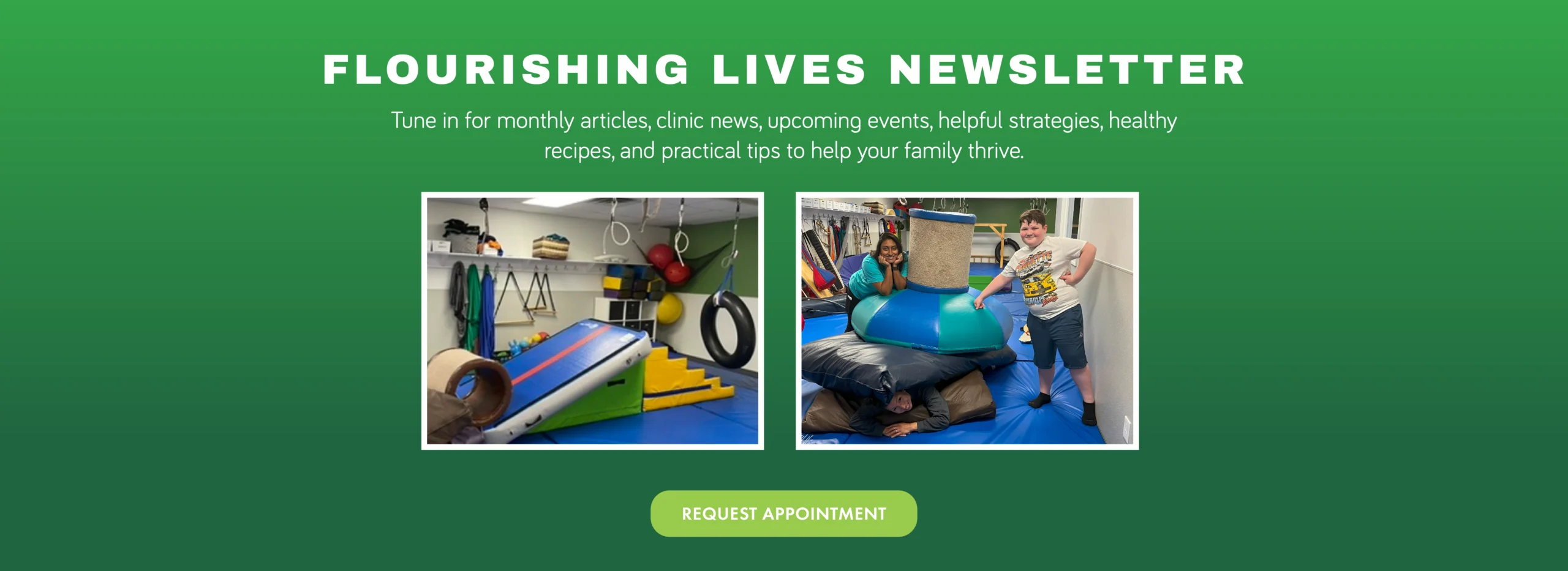
We are so proud of the incredible progress Cole has made in occupational and speech therapy! From building confidence and meaningful connections to strengthening communication, coordination, balance, and motor planning, his growth has been amazing to watch.
Through occupational therapy, he has exceeded his balance goal and is now confidently navigating challenging equipment and obstacle courses with greater independence. His coordination, body awareness, motor planning, and problem-solving skills continue to flourish.
In speech therapy, Cole has made exciting progress producing /l/ and /r/ sounds, often practicing through silly stories filled with creativity and laughter. His social communication skills have also grown tremendously. He is initiating conversations with peers, asking to join activities, expressing his needs, collaborating with others, and even offering a helping hand.
One of his favorite activities is designing imaginative obstacle courses, complete with creative storylines that bring each adventure to life. These activities provide meaningful opportunities to strengthen both motor and communication skills while having fun.
Staff Spotlight: Maya
Maya is one of the administrative assistants families may see at the front desk here at Flourishing Lives. Maya is currently an occupational therapy student working toward her Doctorate of Occupational Therapy degree. Once she has her degree, Maya hopes to become a pediatric occupational therapist, helping children develop the skills they need to thrive in everyday life.
Here at Flourishing Lives, the occupational therapists set a great example and serve as a true source of inspiration for Maya. Even while working at the front desk, she absorbs valuable knowledge from observing therapy sessions, listening to the team collaborate, and interacting with families.
Outside of school and work, Maya enjoys continuing her learning through hands-on experiences and finding opportunities to grow both personally and professionally. She is excited for her future in occupational therapy and is grateful to be surrounded by mentors who encourage her every step of the way.


Cranberry Sauce Oatmeal Bars
- 2 cups leftover cranberry sauce
- 2 cups oats
- 2 cups all-purpose flour
- 1 cup butter (2 sticks), melted
- 1⁄2 cup brown sugar
- 1 teaspoon baking powder
- 1 teaspoon baking soda
- 1⁄2 teaspoon salt
- 2 eggs, beaten
- Preheat oven to 350°F.
- Combine oats, flour, brown sugar, baking powder, baking soda, and salt in a large mixing bowl. Mix well and break up any clumps.
- Add beaten eggs and melted butter to the bowl. Mix until fully combined.
- Prepare a buttered 11 x 8.5-inch baking dish. Spread about two-thirds of the oat mixture along the bottom of the baking dish, pressing down flat. Then spread cranberry sauce as the middle layer. Lastly, spread the remaining one-third of the oat mixture as the top layer.
- Bake at 350°F for 30 minutes. Let cool and cut into bars.
Feel Confident at the Table Again—Without the Power Struggles
- ✓You’re doing everything you can—cutting food just right, offering all the favorites, reading every tip online.
- ✓And still, your child refuses to eat. Or cries. Or gags. Or throws their plate.
- ✓You’re not failing. You’re just missing the right support.
Let’s change that.
We’re Hiring!
Flourishing Lives is growing, and we’re looking for passionate occupational therapists, certified occupational therapy assistants, speech-language pathologists, SLP fellows, and mental health professionals to join our team! If you value connection, play-based learning, and helping children feel confident in their communication, we’d love to meet you. Our unique approach includes:
- ✓Play-based, child-led sessions that build trust and engagement
- ✓Sensory-informed strategies to support attention and regulation
- ✓Strong collaboration with families and other team members
- ✓Focus on functional communication in real-life situations
If you’re looking for a supportive, team-oriented environment where you can make a meaningful impact, we encourage you to apply today.
More Support from Rooted by Flourishing Lives
Looking for guided, step-by-step support between sessions? These self-paced sequences walk families through two of the challenges we hear about most.
Picky Eating Sequence
A guided series for families navigating food refusal, limited variety, and mealtime stress.
View the Sequence →Meltdown Management Sequence
Practical strategies for understanding and supporting your child through big emotions and meltdowns.
View the Sequence →Not sure which resource fits your family, or ready to talk with our team directly?
Contact Us