
Supporting Self-Help Skills Through Occupational Therapy
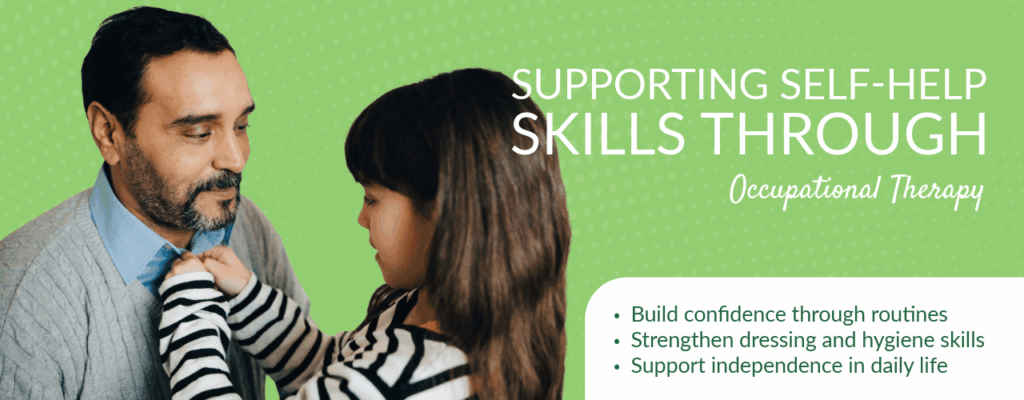
Every child deserves the chance to feel proud of what they can do on their own. Occupational therapy helps children build independence in daily routines such as eating, dressing, and hygiene. These are often called self-help skills, and they play a big role in a child’s confidence and ability to participate in the wider world.
Why Self-Help Skills Matter in Development
Self-help skills are important milestones that reflect a child’s readiness for new challenges. Whether learning to button a shirt, brush teeth, or use utensils, children gain confidence and problem-solving abilities that extend far beyond the task itself.
The occupational therapists at Flourishing Lives work closely with kids to break down these skills into manageable steps and adapt them to each child’s needs. That way, everyday tasks no longer become a source of frustration.
Myths and Facts: Clearing Up Common Misunderstandings
Unfortunately, many myths surround what occupational therapy can and cannot do to support these skills. By separating fact from fiction, families can better understand how therapy empowers children to thrive in everyday life.
Myth 1: Occupational Therapy Only Focuses on Play and Fine Motor Skills
Play and fine motor development are indeed central to occupational therapy, but they don’t show the whole story. Our therapists also target self-help skills directly, recognizing that independence in daily routines is just as important as school or playtime.
For example, activities like tying shoes or washing hands may be woven into sessions to give children real-world practice in a supportive environment. The goal is to empower kids with the ability to care for themselves.
Myth 2: Children Will Eventually Learn Self-Help Skills On Their Own
Many people believe kids will “catch up” over time. While some children do, others need structured support to overcome challenges related to coordination, sensory processing, or attention.
Our occupational therapists identify what is holding a child back and provide strategies to move forward. For instance, if brushing teeth feels overwhelming because of sensory sensitivity, a therapist can introduce tools and approaches to make the routine more manageable.
Waiting it out may only increase frustration, while timely support builds skills and confidence.
Myth 3: Parents Should Not Be Involved in the Process
Some assume therapy happens only during sessions, separate from family life. In reality, parents and caregivers are essential partners.
The occupational therapists at Flourishing Lives actively involve families by sharing strategies, tools, and routines that can be carried over at home. Children make faster and more lasting progress when parents know how to support self-help skills during everyday moments. Collaboration is key to turning small steps in therapy into big leaps in independence.
Myth 4: Occupational Therapy Only Helps Children With Diagnoses
Some parents believe occupational therapy is only for children with specific conditions, such as autism or cerebral palsy. While OT is essential in those cases, it also benefits children without formal diagnoses who may simply struggle with certain daily tasks. Any child who finds dressing, eating, or hygiene more difficult than peers can gain valuable skills through therapy.
At Flourishing Lives, we welcome children of all abilities and tailor our approach to meet their unique needs.
Empowering Children Through Accurate Understanding
Debunking myths helps families see occupational therapy clearly for what it is: a pathway to independence. Self-help skills are essential for daily life, and therapy provides a supportive, structured way to build them. By focusing on small, achievable steps, children learn not only how to complete tasks but also how to feel capable and proud in doing them.
At Flourishing Lives, we believe families deserve clear education and compassionate care. Our therapists work alongside parents and caregivers to create strategies that support independence in dressing, eating, hygiene, and more.
If you’re ready to help your child build confidence through everyday skills, contact our St Clair Shores, MI, and Rochester, MI clinics today to learn more about our personalized occupational therapy services.